
How to Search the Seibert Court Docket
Pull out the paper first. Copy the issuing court, the date, the name, the ticket number, and any case number before you touch a keyboard. Those details answer the key question. A local ordinance process goes back to Seibert, while a County Court or District Court matter belongs to the Colorado docket system in Burlington.
- Read the court heading on the newest Seibert paper and retain every Seibert number.
- Contact Seibert or the named tribunal when the process concerns a local ordinance.
- For a Seibert state matter, open the Colorado Judicial Branch Docket Search and choose Kit Carson County.
- Add a Seibert court type, party, or case-number component because the form will not run on date alone.
- Confirm the newest Seibert setting with the Combined Court at 719-346-5524 extension 3.
A public docket hit is not the whole file. It may show a hearing but no ticket and no signed order. Ask the clerk's Seibert request channels for the Register of Action, a named document, or an authenticated copy instead.
Seibert State Dockets Are County Dockets
State cases from Seibert land in Burlington. The Kit Carson County Combined Court administers them. Its address is 1650 Donelan Avenue, Suite 301. County Court and District Court share one clerk office. Yet each handles different case classes. County Court takes traffic, misdemeanor, small-claims, and limited civil matters. District Court covers felonies, major civil cases, domestic relations, juvenile matters, and probate.
| Seibert matter | State stream | Common class clue |
|---|---|---|
| State traffic | County Court | T |
| Misdemeanor | County Court | M |
| Felony | District Court | CR |
| Civil claim | County or District Court | C, S, or CV |
That clerk office works several request channels. The free docket search is one. Email, phone, and mail are others. So are the statewide web request and the counter in person. Call first. Public hours close from noon to 1:00 p.m. Older records may also sit off site, and a public terminal is not something to count on.
A Seibert record-check email can go to KitCarsonClerksOffice@judicial.state.co.us. Mail to the current Donelan Avenue address, not the former 251 16th Street spot that some older orders still print. The clerk lists fax 719-356-6525. The office should first confirm a given request can travel that way. State the case number with its class and year, the party name, and the exact document. Include your certification choice and delivery contact so the Seibert file gets identified and a cost quoted.
The Seibert Municipal Court
Seibert itself runs no confirmed municipal court. No verified Seibert office, judge, or clerk exists. There is no calendar or public record interface to search either. So nobody can honestly say when Seibert hearings occur or where a local file lives. Read any town-issued paper for the actual tribunal and its contact instructions.
If Seibert works through a periodic or contracted forum, ask the town who keeps the docket. Ask also whether the date still stands and how to request an open record. Check whether the citation names Kit Carson County Court instead. If so, skip straight to the state route. Municipal process does not slide into County Court on its own. State matters, likewise, never have to start in a Seibert tribunal.
No Verified Seibert Pay Portal
No verified Seibert pay portal or city citation lookup exists. A utility or general town bill system is not a docket service. Don't treat it as one. Your true starting point is the process itself and the tribunal it names. For state matters, use the Colorado court docket. The state judicial payment system also serves eligible cases.
Before paying: read the court name and confirm that the payment route applies to the exact Seibert citation.
Paying online can carry the same effect as a plea. That weight is why a failed search matters. Finding no Seibert case proves nothing. The state payment tool does not show whether a case exists or an appearance is cancelled. The matter may be local, unfiled, not payable online, or under a different number. It may also sit outside the tool's eligibility.
Seibert Court Dates and Settings
Verify any Seibert date before you act. Use the newest order, the docket entry, or a statement from the clerk. The local state calendar gives some patterns. Traffic and misdemeanor sessions run the first and third Tuesday at 9:00 a.m. County Court civil matters recur the second Tuesday at 1:30 p.m. These rhythms help you read a calendar. They cannot place your one Seibert case on a date by themselves.
| Date | The current event date after all later reset entries are checked. |
|---|---|
| Time | The listed hearing or docket-call time, not the office schedule. |
| Courtroom | The Burlington courtroom or approved virtual room shown for the setting. |
| Judge | The assigned judicial officer when the public record identifies one. |
| Setting Type | An advisement, pretrial, motion hearing, trial, traffic session, sentencing, or review. |
Showing up in person remains the local state-court default. A generic Webex link is not permission to appear remotely. A judge must approve it, and the clerk can confirm the exact virtual room.
Seibert Citation and Case Numbers
The number on a Seibert citation may not match the court's number. Colorado's state payment tool recognizes this by offering separate case-number and ticket-number modes. The state docket case search also splits a court number into a four-digit year, a class, and a sequence. Keep the distinction in mind whenever a portal rejects an entry.
- Ticket number
- The identifier printed on the issuing process.
- Case number
- The year, class, and sequence assigned to the filed state case.
- Class
- Letters such as T, M, CR, C, CV, or S that identify the docket stream.
- Sequence
- The numeric filing sequence within the year and class.
A sample like 2024T999 shows format only. It is not a real Seibert case. Keep both identifiers handy when a portal match fails or a clerk must trace the filing.
Seibert Traffic Tickets
Where a Seibert traffic ticket lands depends on who wrote it. A ticket may run through the Colorado County Court stream or through a Seibert ordinance process. So read the issuing court on the ticket instead of guessing. State cases often carry class T and can show up in the Kit Carson docket. The clerk can hand over a Seibert ROA, a ticket copy, or a disposition order. That applies when it is public. If the town holds the file locally, the town's named municipal custodian handles it.
Colorado's state payment tool takes an eligible Seibert search by case number, ticket number, or name with birth date. Treat it as a balance and payment tool only. It is not the full Seibert case history. No universal Seibert fine list, defensive-driving offer, deferred option, or payment deadline is confirmed. So check the tribunal before acting. Skipping a court date can bring further court action or licensing consequences.
For the wider route on Seibert state tickets, the Kit Carson County traffic court record also helps. It keeps the DMV driving record separate from the Seibert court file.
Seibert Court Docket Search Limits
The free Colorado docket page works best for public calendar events. A result there can show the courthouse or county, the court type, the division, the date and time, the case number, the party display, and the hearing type. It does not promise every filed image, a certified result, or protected information. A Seibert name search can miss a case too. Spelling, location, class, restriction, or a changed attorney can all hide a record. But a careful read of the result helps.
| Question | Best Seibert source |
|---|---|
| When is the state hearing? | State docket plus clerk confirmation |
| What public events occurred? | Register of Action request |
| What does the signed order say? | Named document request |
| Where is a local ordinance file? | Town or tribunal printed on process |
Result pages may offer print and export controls. Handy, but a button does not make a result official. Convenience is not certification.
When a Seibert result appears, write down the court, division, case number, party display, event label, and date before you leave the form. Need a filed paper? The statewide request form lets you pick the ROA, a Ticket, a Disposition/Sentence Order, or another exact document. Include the case number, because a name-search fallback costs an added $5. The form's three-business-day window is a response target, not a promise that production, redaction, or off-site retrieval will finish that fast.
Where Seibert Cases End Up
A Seibert local ordinance process follows the tribunal and appeal path set by valid court papers and Colorado law. No official city structure is confirmed, so an exact appeal route cannot be promised. State cases are different. They begin in County Court or District Court based on jurisdiction, with no prior Seibert municipal filing needed.
Docket flow: Seibert local ordinance process › applicable Colorado appeal path › Kit Carson County District Court
A County Court appeal or a qualifying municipal appeal can reach District Court. Most District Court judgments then go to the Colorado Court of Appeals. Transfers and appeals may carry new case numbers, so keep both when a Seibert notice points to an earlier file.
Seibert Court Docket Is Not Bankruptcy
Living in Seibert does not put a state or local matter into federal bankruptcy CM/ECF. Bankruptcy is its own federal proceeding, with its own court, case number, and PACER-backed access. State cases stay with the Combined Court. Any local ordinance process stays with its named local tribunal.
The official U.S. Bankruptcy Court for the District of Colorado shows the separate federal system in its own pages.
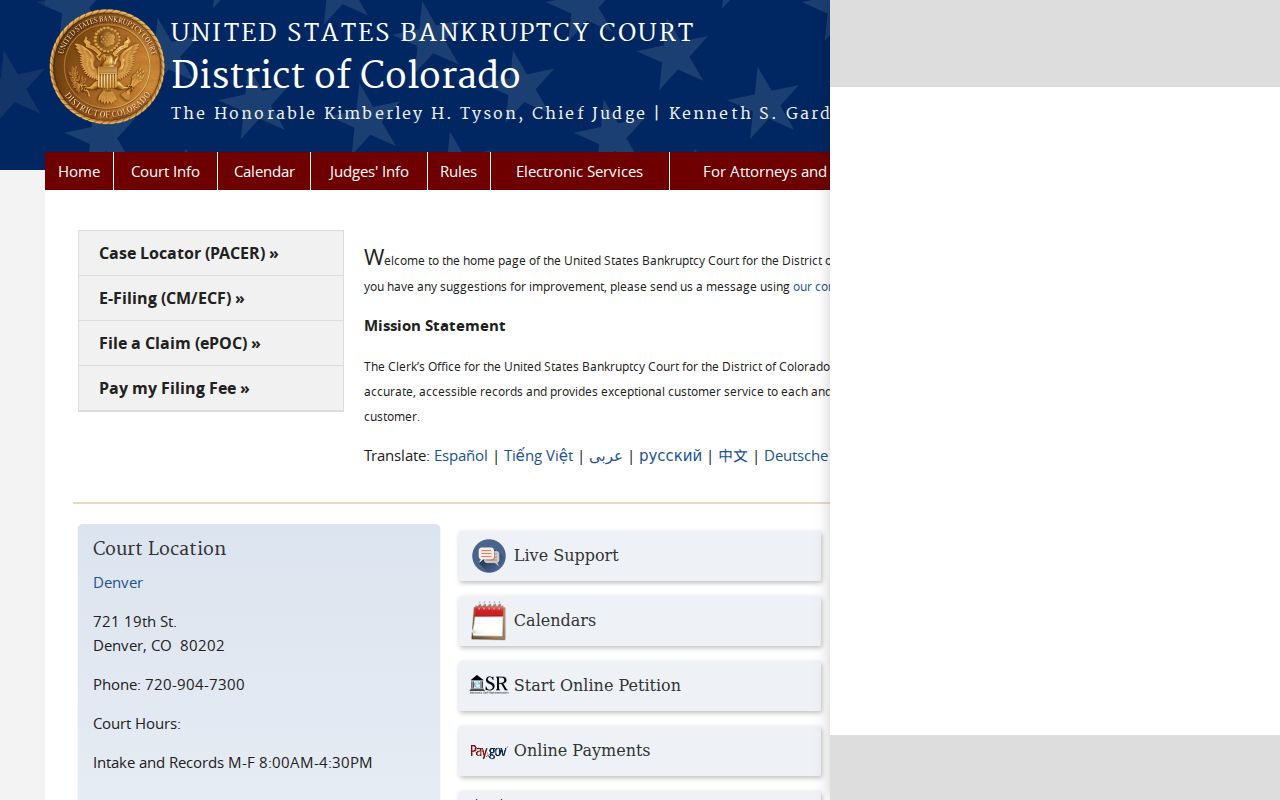
The court homepage makes clear this is a separate federal system. That distinction keeps a Seibert state lookup from going to the wrong office.
For the filing side, the official Colorado Bankruptcy CM/ECF information covers the electronic docket system itself.
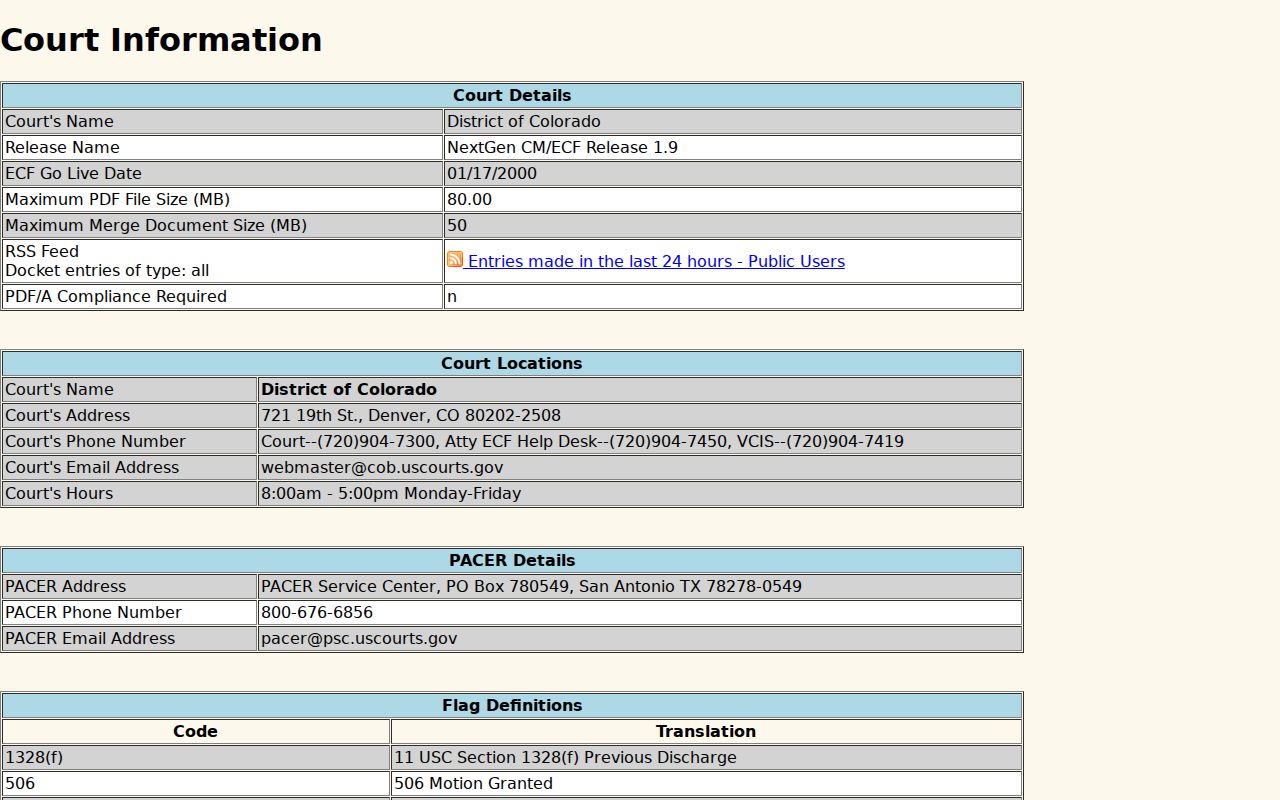
The system information describes federal electronic filing and docket access. It is not a Seibert municipal portal or a Colorado state ROA.
Public Access to Seibert Court Records
For open Seibert state court records, the request goes through the Clerk of Court at the Combined Court. CJD 05-01 governs how the custodian reviews files. It also sets what counts as public, what data stays protected, and what appears remotely. The Colorado Open Records Act covers many government records. Judicial case files, though, follow the court-specific directive and the clerk process.
Key rules:
CJD 05-01 controls access to Colorado court records and protected information.
Colorado public-record and sealing law explains other access duties and why some criminal records leave ordinary searches.
Colorado Children's Code limits juvenile record access.
A public docket does not promise anonymous document images. When you need official authentication, request a certified copy.
Older Seibert Court Docket Files
Start with the Combined Court for an older Seibert state file. The clerk can tell you where it sits. It may be on site, need off-site retrieval, or have moved to the Colorado State Archives. Retrieval may carry a real cost. The statewide form's three-business-day statement is a response target, not guaranteed completion.
The official Kit Carson County Clerk of Court profile gives the right contact. Use it for Seibert state-record questions.
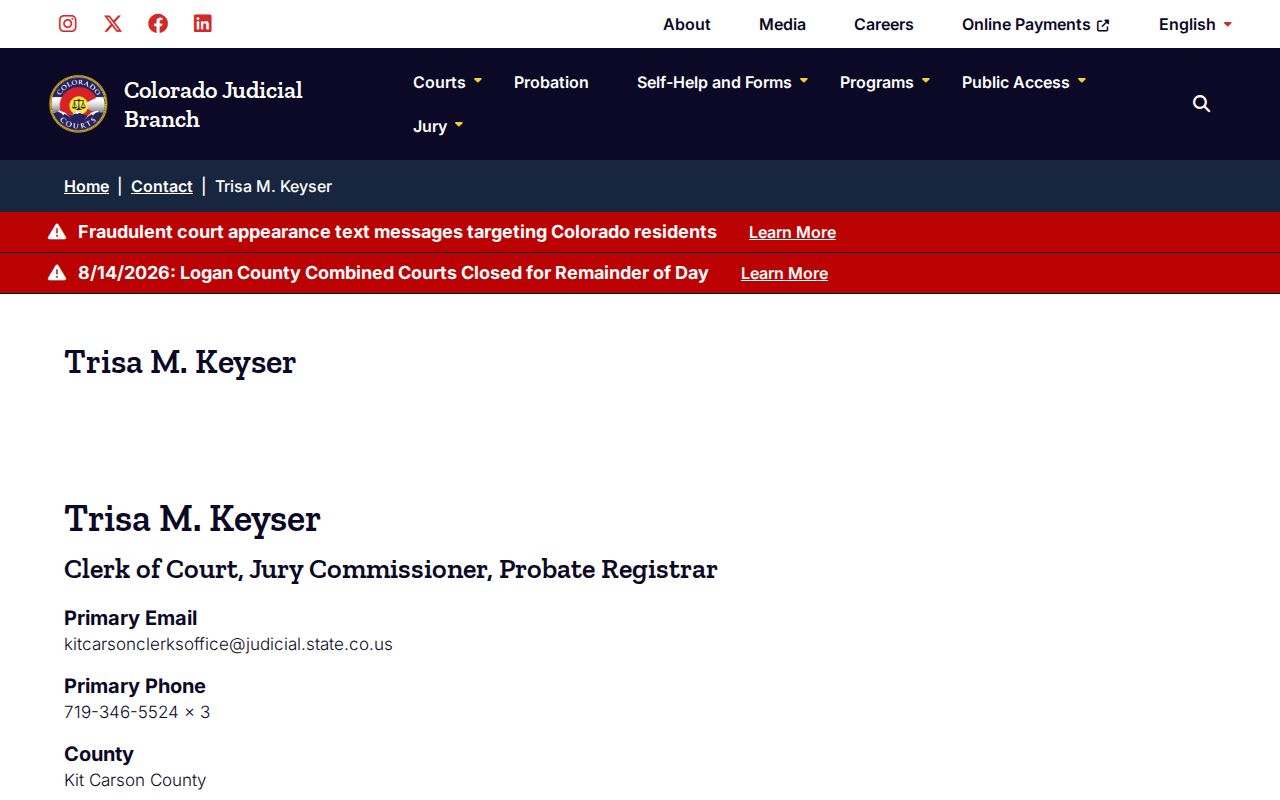
That clerk contact is the right start for Seibert. It covers old, off-site, sealed, suppressed, probate, juvenile, or protected files.
A missing public result does not prove a case never existed. Check the court, class, date, spelling, and the town-versus-state route. Then ask what identification, proof of role, redaction, or court approval is required. Some restricted records demand government photo identification.
State charges can help you plan the request. A single-sided copy runs $0.25 per page. A double-sided copy is $0.50 per page, and certification or exemplification costs $20 per document. Parties and their attorneys face a $15 copy maximum per case; no nonparty maximum is stated. Research and redaction can be billed after the first hour. These are court-record charges, not Seibert municipal fines, so let the clerk assess the actual order before you pay.